

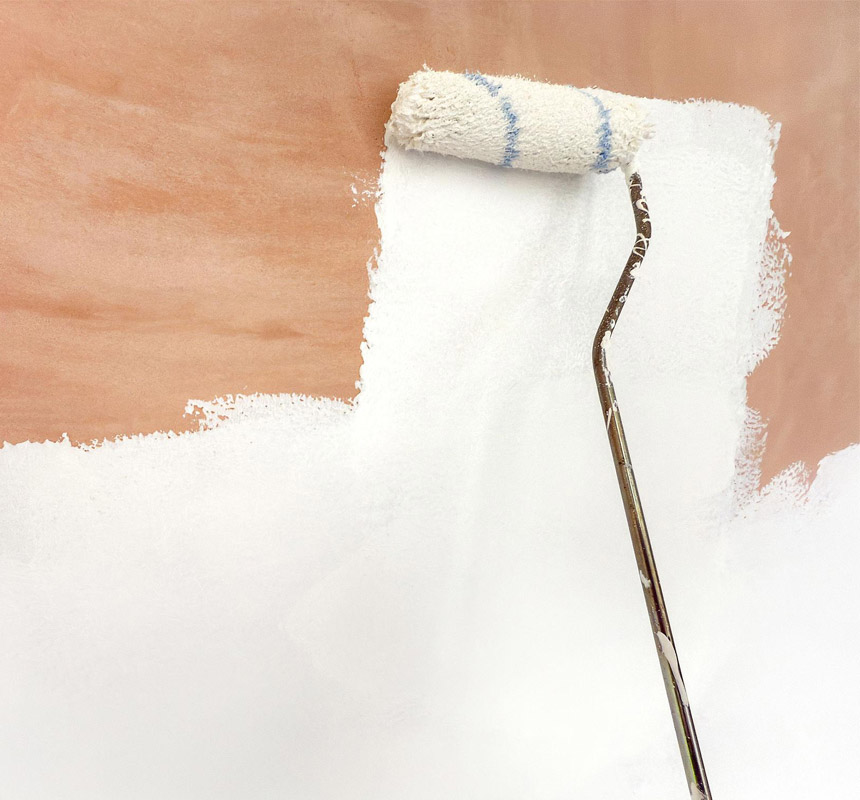

What is a primer, and why and when should you use it?
A primer is a coating applied directly to the surface before the final paint finish.
Its purpose is to penetrate the surface pores, seal and protect the substrate, improve water resistance where required, and ensure strong adhesion with a smooth, uniform final result.
Choosing the right primer plays a key role in extending the life of the paint system and helps prevent issues such as peeling, uneven coverage and reduced adhesion.
Guided by the specific requirements of each surface, Superlux offers a range of high-technology primers for interior and exterior use.
Desmo solvent-based
Desmo solvent-based is a transparent, colourless, acrylic-based insulating primer for architectural paints.
It is suitable for surfaces that will be coated with:
• emulsion paints,
• water-based or solvent-based acrylic paints,
• textured coatings,
• insulating materials,
• and decorative render finishes.
It can be applied to:
• concrete,
• plasterboard,
• render,
• plaster,
• wood,
• MDF,
• brick,
• as well as old surfaces with adhesion problems.
It stands out for:
• its high penetrating ability,
• strong adhesion,
• water-resistant properties,
• and its ability to isolate dirt and stains, preventing them from bleeding through to the final paint finish.
It is an ideal solution for priming before the final coat of paint and replaces traditional linseed oil-based priming methods.
Desmo water-based is a transparent, micronised acrylic water-based primer based on new-generation technology.
It is:
It is recommended for emulsion and acrylic paints for interior and exterior use, and is ideal for preparing new surfaces.
It is particularly recommended for surfaces containing:
It stands out for:
It is an excellent choice for:
Acryl Bond is an acrylic-based primer for acrylic and emulsion paints, and can be diluted up to 300–400% with water.
It is suitable for all surfaces and all water-based paints.
It provides:
It is particularly effective on alkaline surfaces such as:
<p>On a new surface to be painted, the use of a primer is considered essential.</p>
<p>On previously painted surfaces, however, it is important to first assess the condition of the wall before deciding whether priming is required.</p>
<p>The fact that a surface has already been painted does not necessarily mean that it is in good condition, or that it will not present adhesion or uniformity issues.</p>
<p>Walls with:</p>
<ul>
<li>dirt,</li>
<li>dampness,</li>
<li>flaking or unstable areas,</li>
<li>or old, poor-quality paints,</li>
</ul>
<p>require proper preparation, thorough sanding and the application of a suitable primer before repainting.</p>
<h3>In summary</h3>
<p>Correct priming is essential for:</p>
<ul>
<li>strong adhesion,</li>
<li>a uniform final finish,</li>
<li>a longer-lasting paint system,</li>
<li>and the prevention of future problems.</li>
</ul>
<p>Do not underestimate its importance, as it can help prevent significant surface damage and repeated repair work in the future.</p>

Stay informed about new products, technical advice, colour trends and the latest news from Superlux.
High-quality paints & varnishes industry. Since 1975, we create solutions that stand the test of time and enhance every surface.
Technical Data Sheets
Certifications
Contact
Support
© All Rights Reserved 2020
Πολιτική Απορρήτου | Cookies | Όροι Χρήσης
Adding {{itemName}} to cart
Added {{itemName}} to cart